
An architectural concept statement is the short text that tells a competition jury what your design is trying to do and why. It names the problem in the brief, states the one idea that answers it, and explains how the drawings prove that idea, usually within a strict word or character limit set by the organizer.
The examples in this guide come from published competition rules, not from opinion. Limits range from a 100 word summary to a 600 word statement, and every one of them rewards the same habits: a clear reading of the brief, one idea stated early, and evidence that sits on the boards rather than in adjectives.
What is an architectural concept statement?
It is the written half of a competition entry. The boards show the design; the statement tells the jury how to read them. In most ideas competitions the jury meets the text and the images together, without you in the room, so the statement has to do the explaining that you would otherwise do in a presentation.
The RIBA’s competition entry guidelines describe the task plainly for the open design phase: describe the design concept in detail, explain the drivers behind your proposed approach, and avoid complex technical descriptions. That is a good working definition. A concept statement is not a project description, a sustainability report or a list of materials. It is an argument for one way of answering the brief.
Competitions call it different things. eVolo asks for a “project statement”, the iF Design Student Award for a “design statement”, the Fentress Global Challenge for a summary on the first page of the design concept, and Europan for an illustrated text. The name changes; the job does not.
How long should a concept statement be?
Exactly as long as the rules allow, and no longer. There is no standard length, and the limits below show how far apart competitions are. Write to the limit of the competition you are entering, not to a template from the last one.
| Competition | Text limit | What else is submitted |
|---|---|---|
| Fentress Global Challenge 2026 | Summary of up to 100 words on page one | Up to eight landscape pages, anonymous |
| AR House 2026 | About 250 words on the boards | Two A2 boards with a plan and a section |
| eVolo Skyscraper Competition 2027 | Project statement of up to 600 words | Two horizontal 24 x 48 inch boards |
| iF Design Student Award 2027 | Design statement of up to 650 characters | One A1 landscape poster and two images |
| Europan 18 | Illustrated text of up to four A4 pages | Three vertical A1 panels |
Limits as published in each competition’s official brief or entry guide, as of November 2026.
Two things follow from the table. First, a character limit is far tighter than it looks: 650 characters is roughly 100 words, so the iF statement has room for the problem and the result and very little else. Second, where the text lives matters. AR House puts its 250 words on the boards, which means the text competes with drawings for space, while eVolo takes a separate document that the boards should not have to repeat.
Read the brief before you write the concept
A concept statement fails most often because it answers a question the brief did not ask. Before you write anything, mark three things in the brief: the problem the organizer wants solved, the criteria the jury will use, and the format rules that can disqualify you.
Find the question the jury will ask
Good briefs state their question directly. The Fentress Global Challenge 2026 brief asked for an airport terminal and listed practical criteria: high quality graphics and writing, a logical layout and no repeated information. The Kaira Looro 2027 brief asks for a health center that responds to the local climate, respects the community’s cultural identity and can be built with local means. If your first sentence does not answer that question, the jury has to go looking for the answer, and many will not.
Copy the criteria into your outline
The iF Design Student Award scores every entry against five criteria, from problem solving to economic relevance. When a competition publishes its criteria like this, turn them into the skeleton of your statement. A sentence on how the idea works, a sentence on who it serves, a sentence on how it could be built or run. You do not need to name the criteria, but the jury should be able to tick them off.
💡 Pro Tip
Paste the brief’s evaluation criteria into the top of your draft and delete each one only when a sentence in the statement answers it. Whatever is left at the end is the part of the brief your entry has ignored.
Note the rules that can remove you
Anonymity rules apply to the text as much as to the boards. The UIA Competition Guide says names, logotypes, symbols or other identifying marks may not appear in any form, and that an entry is excluded if its author breaks anonymity. In practice that means no studio name, no school, no “our previous project in Lisbon” in the statement. eVolo uses the registration number as the only identification and disqualifies entries with identifying marks.
How to write an architectural concept statement in six steps
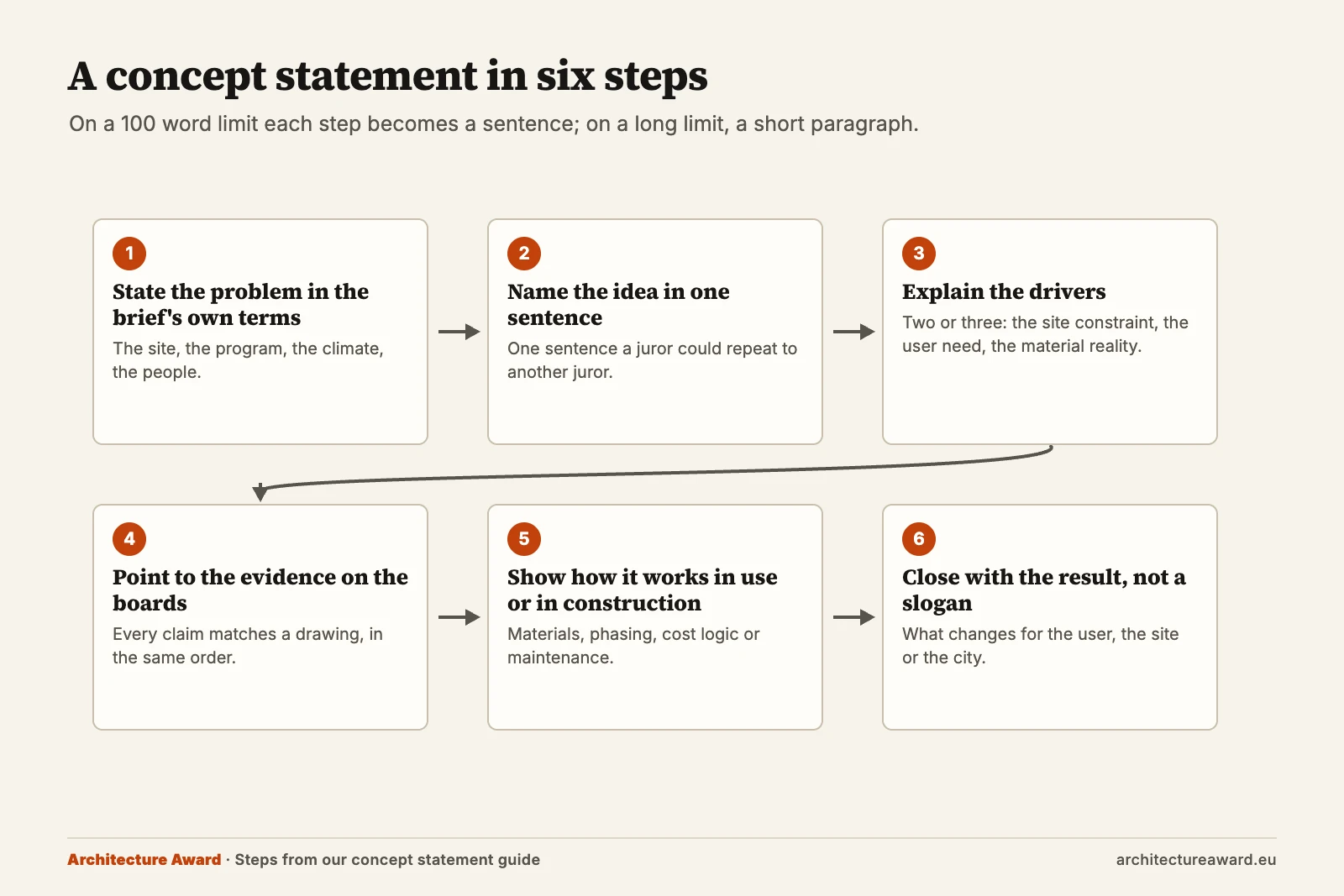
The steps below work for a 100 word summary and a 600 word statement alike. On a short limit, each step becomes a sentence; on a long one, a short paragraph.
1. State the problem in the brief’s own terms
Open with the condition you are responding to: the site, the program, the climate, the people. Use the brief’s vocabulary so the jury recognizes its own question. “Rural clinics in the region lose staff because buildings overheat” says more than “Healthcare is a global challenge.”
2. Name the idea in one sentence
This is the core of the concept statement: one sentence that a juror could repeat to another juror. “The roof collects rain and shade first; the rooms are arranged under it” is an idea. “A sustainable, community-focused design that connects people and nature” is a list of hopes. If you cannot write the idea in one sentence, the design probably has more than one, and the boards will show that too.
3. Explain the drivers
Say why this idea and not another. The RIBA guidance asks entrants to explain the drivers behind the proposed approach, and that is where an architectural concept earns its credibility: the site constraint, the user need or the material reality that made the decision. Keep it to two or three drivers. A jury reading dozens of entries remembers reasons, not lists.
4. Point to the evidence on the boards
Every claim in the statement should match a drawing. If you write that the plan allows the building to grow in phases, the jury should find the phasing diagram. Writing “see section A” is not necessary, but the order of the statement and the order of the boards should be the same, so the reader moves through both together.
⚠️ Common Mistake to Avoid
Repeating the board text in the statement, or the statement on the boards. The Fentress criteria ask for a layout without repeated information, and eVolo’s separate 600 word statement is space you lose if it only describes what the drawings already show. Use the text for what images cannot say: reasons, sequence, how the building is used or built.
5. Show how it works in use or in construction
Ideas competitions are speculative, but juries still test feasibility. The iF jury checks economic relevance alongside design, and the Europan 18 rules expected the panels to set out a method for implementation, not only a final image. One short paragraph on materials, phasing, cost logic or maintenance makes a bold idea easier to believe.
6. Close with the result, not a slogan
End with what changes for the user, the site or the city if the idea is built. A measured result (“a classroom that stays below outdoor temperature without mechanical cooling”) is stronger than a slogan (“architecture for a better tomorrow”). If the brief asked a question, the last sentence should read as the answer.
Writing style that juries can read quickly
Write in plain, active sentences. A jury may read the statement in a second language, and many briefs require English. Short sentences survive translation tools and tired readers better than long ones.
- Use present tense for the design (“the roof collects rain”), not the conditional (“would collect”).
- Replace adjectives with facts: dimensions, numbers of users, materials, hours of daylight.
- Define any technical term the first time you use it, or leave it out.
- Keep one idea per paragraph and lead each paragraph with its point.
- Read the final text aloud against the boards to check that the order matches.
If you find yourself writing “innovative”, “iconic” or “sustainable” without a number or a mechanism after it, cut the word and write the mechanism instead. For a longer look at how an idea grows from site and program into a design, this note on architectural concept development covers the earlier, studio side of the process.
Fitting the statement to the format
The same concept needs different writing depending on where the text appears. Three formats cover most competitions.
Text on the board
When the words sit on the boards, as in AR House or on the iF poster, treat the text as part of the layout. Place the one sentence idea near the main image, keep the rest in short blocks beside the drawings they explain, and use a type size the jury can read when the board is printed. The iF poster template is strict: one A1 landscape page with fixed strips for the entry ID and concept text in about 20 pt, so plan the text block before you place a single image.
A separate statement file
When the text is a separate document, as at eVolo, it can carry the reasoning that would clutter a board: how the building works, why it is that height, what happens over time. Start it with the same one sentence idea as the boards so the two read as one entry.
A summary inside a longer document
Fentress asks for an eight page design concept that opens with a title, a signature image and a summary of no more than 100 words. That summary is the most important text in the entry, because it is what the jury reads first. Write it last, after the pages are finished, and make it answer the brief in the first sentence.
📌 Did You Know?
Fields are often smaller than they look from outside. eVolo’s 2025 results named 3 winners and 14 honorable mentions from 149 projects, according to the competition’s published results, while the iF Design Student Award honored 90 concepts from more than 7,000 entries in 2026. A precise statement matters more in the second kind of field, where the online jury round has to cut thousands of entries to 300.
A short example, rewritten
The two versions below describe the same imaginary entry, a community kitchen on a flood-prone riverbank, written for a 100 word limit.
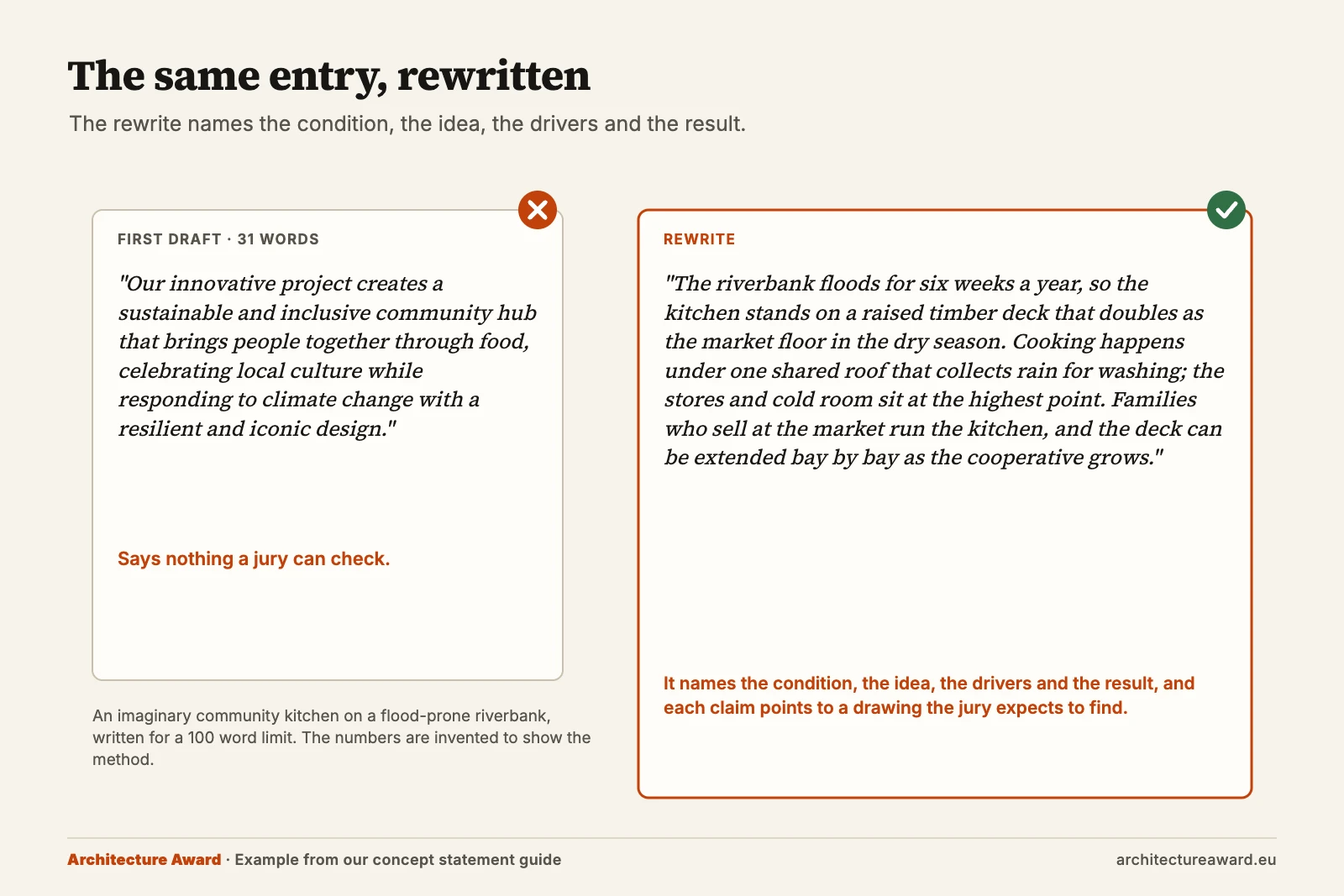
The first draft reads: “Our innovative project creates a sustainable and inclusive community hub that brings people together through food, celebrating local culture while responding to climate change with a resilient and iconic design.” It uses 31 words and says nothing a jury can check.
The rewrite reads: “The riverbank floods for six weeks a year, so the kitchen stands on a raised timber deck that doubles as the market floor in the dry season. Cooking happens under one shared roof that collects rain for washing; the stores and cold room sit at the highest point. Families who sell at the market run the kitchen, and the deck can be extended bay by bay as the cooperative grows.” It names the condition, the idea, the drivers and the result, and each claim points to a drawing the jury expects to find.
The numbers in the example are invented to show the method; your statement should use the measured facts of your own site and brief.
Putting it all together
Deadlines decide how much time you have to rewrite. Our student competitions calendar and the list of open architecture competitions show current closing dates checked on each organizer’s official site.
Quick Recap:
- Write to the limit and format of the competition you are entering, not to a general template.
- Put the problem and your one sentence idea at the start, in the brief’s own terms.
- Use the remaining words for drivers, evidence and how the design works, never to repeat the boards.
- Check anonymity and file rules before you submit, because they can remove an entry before judging.
Word limits, formats and dates change with each edition. Confirm them in the official brief before you enter.