A strong award submission answers the organizer’s questions in order, proves the project is eligible, and lets photographs and plain facts carry the argument. At the first stage of judging, the jury sees only the material you upload, so the text, the images and the category choice have to do the work without you in the room.
The examples below come from two sets of published rules: the RIBA Awards entry requirements for 2027 and the Dezeen Awards rules for 2026. They are different kinds of programs, a professional institute and a design magazine, and comparing them shows which habits help in almost any award submission.
What does an award submission have to do?
It has to win a first reading by people who have never seen your building. The Dezeen Awards terms put it bluntly: “Entries will be judged solely on the material submitted.” Judges cannot visit, call you, or guess what you meant, so anything that is not on the form does not exist for them.
That gives every submission three jobs. It must clear the eligibility rules, or it is removed before judging. It must answer the questions the form asks, in the space allowed. And it must give the jury enough evidence, in words and images, to rank the project against the other entries in the same category.
Read the rules before you write a word
Rules decide whether you can enter at all, and they change with every edition. Start with the terms page, not the fee page, and note four things: the completion window, who may submit, what images are allowed, and what you are signing away.
Completion and occupation dates
Each program sets its own window. For the 2026 Dezeen Awards, architecture and interiors projects had to be completed between June 1, 2024 and May 31, 2026, and “completed” meant handed over to the client. For the RIBA UK Awards 2027, projects must have been completed between January 2024 and January 2026 and occupied by January 2026, with partially occupied projects subject to RIBA approval. A building that is finished but empty can miss a window that a casual reading would say it meets.
Who is allowed to submit
Both programs require the client’s permission. RIBA asks that entrants “must have the client’s permission to submit the project”, and for the UK Awards the project director must be a current Chartered Member of RIBA or one of its sister institutes in Wales, Scotland and Northern Ireland, or a RIBA International Affiliate Member. Dezeen requires entries to come from, or be made with the permission of, the architect or studio chiefly responsible, and the same project may be entered only once per category. Ask the client early: a permission email can take longer than writing the text.
Image rules
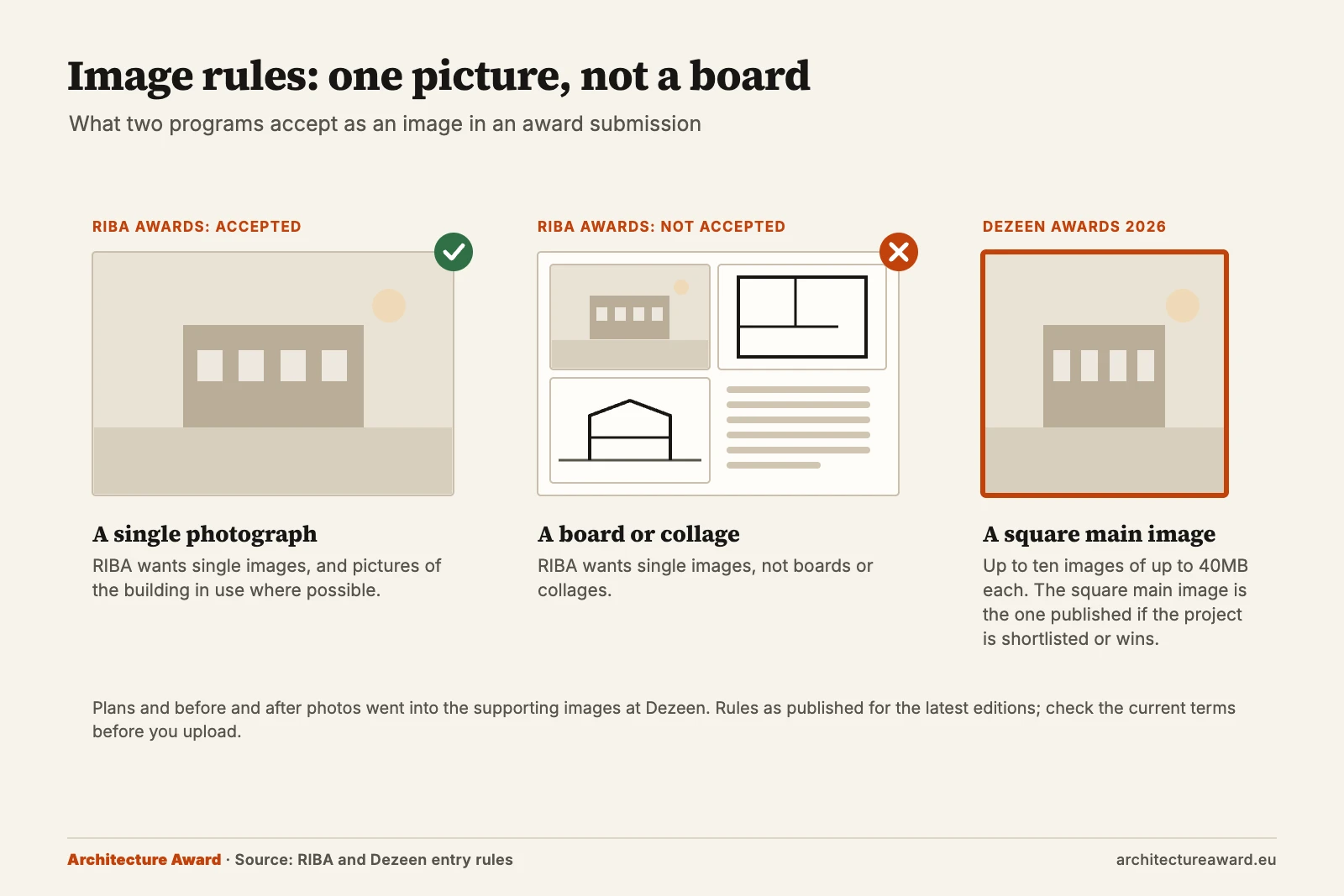
This is where programs differ most. RIBA states that “computer-generated renders and AI-generated images will not be accepted” and wants single photographs of the completed building, without logos, titles or captions. Dezeen required at least one photograph of the completed project and accepted computer generated images only as captioned supporting material of secondary importance.
⚠️ Common Mistake to Avoid
Reusing the image set from a competition or a client pitch. Renders and composite boards that work in a pitch can make an entry ineligible at RIBA and count for little at Dezeen. Build the award image set from photographs of the finished building, and add drawings only where the form asks for supporting material.
How to write the project description
RIBA’s form separates a short summary that may be published if you win from a longer description for the jury. It asks for a brief overview “written in the third person” and then a separate description, and tells entrants: “Please do not repeat your Project Summary text here.” Treat the two as different documents with different readers.

Lead with the brief and your answer to it
Open with what the client asked for, what made the site or budget difficult, and what you did about it. The Dezeen entry guidance asks for the brief, the materials and how the building is made, plus any inclusive design thinking and any strategy to reuse material and reduce waste. In 2026 each Dezeen judge scored between 30 and 60 projects across three categories, so the decision that defines your project belongs in the first lines, not in the last paragraph.
Write facts, not adjectives
The same Dezeen guidance tells entrants to write “succinctly and clearly, avoiding exaggeration and sticking to the facts where possible.” In practice that means floor areas, dates, numbers of users and measured results instead of words like “unique” or “stunning”. RIBA’s form asks for the gross and net internal area in square meters, and planning approval, completion and occupation dates, so have those figures ready before you start.
💡 Pro Tip
Write the summary as if a journalist will copy it word for word, because RIBA says it may publish the summary if you win. Leave out anything the client wants kept private, and check every name and credit before you submit.
Bring evidence on sustainability and access
Sustainability is no longer an optional paragraph. RIBA’s 2027 entries must meet its sustainability criteria, “including actual energy data, water usage and relevant carbon calculations”, which means measured data from occupation, not design targets. RIBA also asks for an inclusive accessibility statement of approximately 100 words. Dezeen asked every 2026 entrant for sustainability information and judged entries against it. Start collecting meter readings and carbon figures months before the deadline; they cannot be produced in the last week.
Respect the word limits
Word limits are part of the test. Dezeen states its limits on the entry form and does not count spaces. When a field is short, cut background first and keep the decisions and the evidence. If a limit leaves no room for a point, ask whether a drawing or a caption can make it instead.
Choosing photographs and drawings
Images carry much of the argument, and the specifications are strict. For 2026, Dezeen allowed up to ten images of up to 40MB each, with a main image uploaded as a square that is also the one published if the project is shortlisted or wins. Plans and before and after photos went into the supporting images. RIBA wants single images, not boards or collages, and pictures of the building in use where possible.
📐 Technical Note
RIBA’s general image rules ask for file names under 30 characters that describe the subject, with no special characters such as * % + or the copyright sign. A name like “north-facade-dusk.jpg” passes; “Final_v3 (2)+edit.jpg” does not.
Choose one drawing type per idea. A section explains a daylight strategy faster than a paragraph, and a simple site plan shows context in seconds; this overview of types of architectural diagrams helps you pick the right one. Then check the rights. RIBA requires confirmation that the copyright owner of each photograph has licensed its use in all media in perpetuity, and photographers are credited on their images, so agree this with your photographer before the shoot, not after the shortlist.
Picking the right category
The category decides who you are compared with. Dezeen let entrants put the same project into several categories if it fitted each one, but every category was a separate fee, and the 2026 categories were defined by use and size, for example workplace project (small) and workplace project (large). RIBA’s International Awards add a fee of GBP 100 for each category entered (as of November 2026).
Read each category description in full before choosing. A house extension entered as a new house competes against projects with a different brief. If two categories fit, enter the one where the project’s main decision is the thing being judged.
What to check before you pay
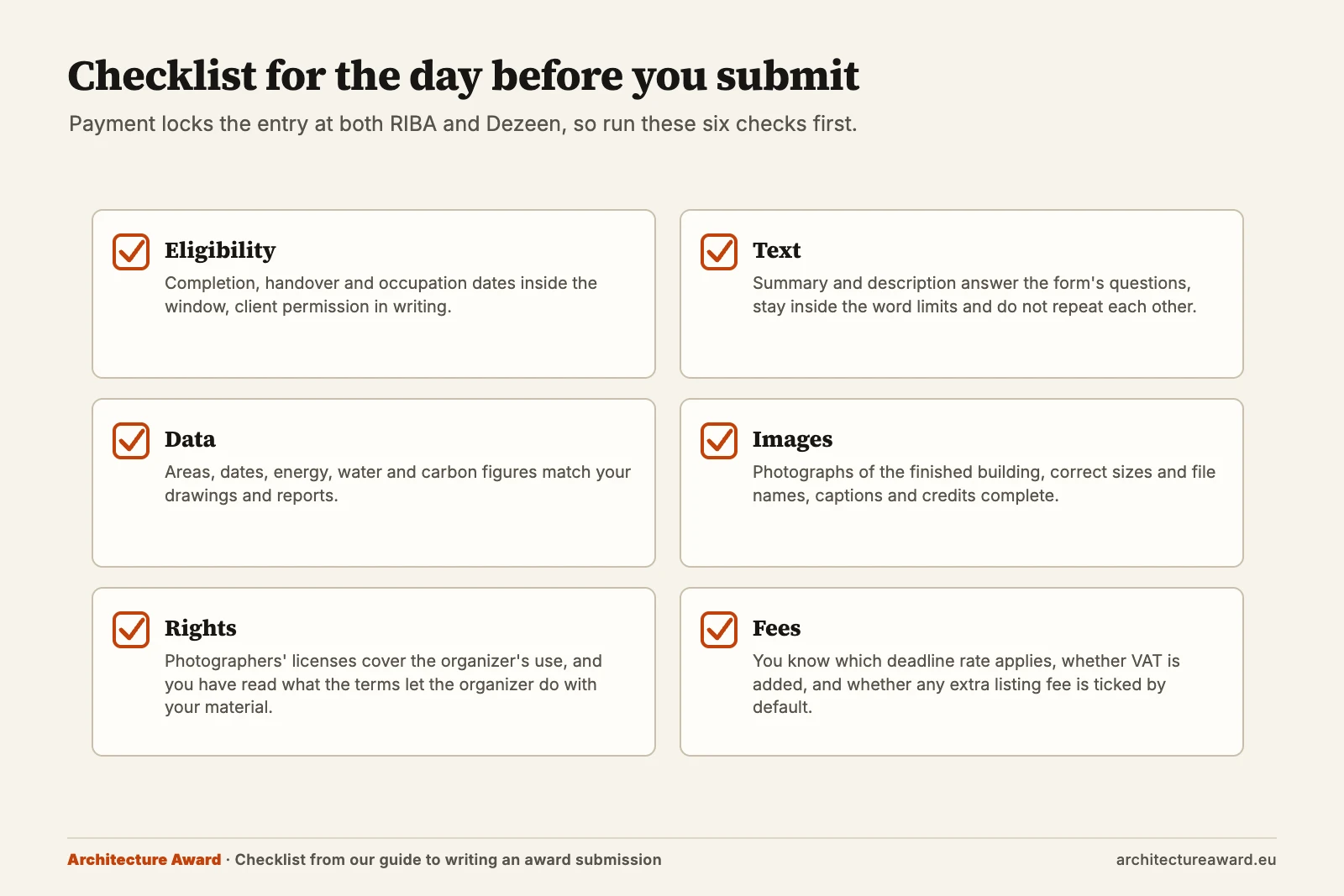
At both programs, payment locks the entry: Dezeen says you cannot change it after payment, and RIBA says the same. Dezeen also did not refund fees on withdrawal or disqualification. Use the checklist below on the day before you submit.
- Eligibility: completion, handover and occupation dates inside the window, client permission in writing.
- Text: summary and description answer the form’s questions, stay inside the word limits and do not repeat each other.
- Data: areas, dates, energy, water and carbon figures match your drawings and reports.
- Images: photographs of the finished building, correct sizes and file names, captions and credits complete.
- Rights: photographers’ licenses cover the organizer’s use, and you have read what the terms let the organizer do with your material.
- Fees: you know which deadline rate applies, whether VAT is added, and whether any extra listing fee is ticked by default.
RIBA and Dezeen entry rules compared
The table sets the two programs side by side, as published for their latest editions.
| Rule | RIBA UK Awards 2027 | Dezeen Awards 2026 |
|---|---|---|
| Completion window | January 2024 to January 2026, occupied by January 2026 | June 1, 2024 to May 31, 2026, handed over |
| Who submits | Project director with RIBA or linked institute membership, client permission | Lead architect or studio, or others with their permission |
| Renders | Not accepted, nor AI images | Supporting only, captioned, secondary weight |
| Text | Third person summary plus separate description | English, within form word limits |
| Sustainability | Actual energy, water and carbon data | Sustainability information judged in every entry |
| Changes after payment | Not possible | Not possible |
Rules as published on each award’s official pages; RIBA as of November 2026, Dezeen for the 2026 edition.
📌 Did You Know?
Not every major award has a submission at all. The Pritzker Architecture Prize FAQ says there are no forms and no portfolios required: any licensed architect may nominate a living architect by email, through November 1 of each year, for the following year’s prize.
Where to go from here
Deadlines decide how much time you have for all of this. RIBA’s 2027 entries opened on November 10, 2026 and close on January 14, 2027, with early bird discounts until December 10, 2026 (as of November 2026). Our deadline calendar lists closing dates and fees checked on each award’s official site, and our methodology explains how those checks are made.
Your Next Step: Open the terms page of the award you plan to enter, copy its completion window, image rules and word limits into one document, and check your project against each line before you draft any text.
Dates and fees change with each edition. Confirm them on the official award website before you enter.