The best architecture competitions for students to start with are the ones your school can enter for you, the free open calls with a clear brief, and one paid ideas competition you choose on purpose. Below are nine with their next deadline, entry fee and eligibility as published on their own sites (as of November 2026).
Each listing gives the deadline and fee first, then what the competition asks for and where it can go wrong. Fees are per entry or per team as the organizer states them, and dates for closed cycles are marked as closed rather than carried into the next year.
1. RIBA President’s Medals – Royal Institute of British Architects
Next deadline: 2026 entries closed in July 2026; winners named December 2, 2026 | Entry fee: none for schools with RIBA-validated courses, GBP 480 per entry for other schools | Who can enter: invited schools nominate students | Frequency: annual (as of November 2026)
The RIBA President’s Medals were first given in 1836 and now cover three medals: Bronze for a Part 1 design project, Silver for a Part 2 project and the Dissertation Medal. You cannot apply yourself. Invited schools nominate up to one dissertation, two Part 1 projects and two Part 2 projects from the academic year that has just ended, and schools without RIBA-validated courses pay the GBP 480 fee per entry.
That makes the medals a school decision, not a student one. If your tutor thinks a project is strong, the conversation needs to happen before the summer, because the key dates page put the 2026 deadlines in late July, after most studios had finished. Ask early whether your school takes part and how it picks its two projects per level.
📌 Did You Know?
The first Silver Medal went to George Godwin in 1836 for an essay on the nature and properties of concrete, according to the President’s Medals history page. In 2025 the medals drew a record 378 entries from 110 schools across 30 countries.
2. ACSA Student Design Competitions – Association of Collegiate Schools of Architecture
Next deadline: faculty registration April 7, 2027; final submission June 2, 2027 | Entry fee: none | Who can enter: students at ACSA member schools with a faculty sponsor | Frequency: annual (as of November 2026)
The ACSA competitions page lists four free competitions for 2027: the AIA COTE Top Ten for Students with USD 13,500 in prizes, the Steel Design Student Competition and the Concrete Masonry Design Competition with USD 20,000 each, and Design for Freedom with USD 14,000. The Steel competition, sponsored by AISC, reaches its 27th edition in 2027.
Two limits matter. A faculty sponsor must register you, and the Steel and Concrete Masonry competitions are open only to schools in the US, Canada and Mexico, while COTE and Design for Freedom accept ACSA member schools worldwide. The COTE rules ask for no more than two digital boards of 24 by 36 inches, and a name or school on the boards disqualifies the entry. These work best when a whole studio adopts the brief for a semester.
3. iF Design Student Award – iF Design
Next deadline: February 3, 2027, 23:59 CET | Entry fee: none | Who can enter: enrolled students and graduates of up to two years, teams of up to four | Frequency: annual (as of November 2026)
The iF Design Student Award splits EUR 50,000 in prize money among the best concepts; in 2026 seven top concepts shared it. Each entry goes into one of 15 categories built on the UN Sustainable Development Goals, from No poverty to Life on land, and the same concept cannot be entered in several.
The workload is light: two images, one A1 landscape poster as a PDF of up to 5MB and a design statement of no more than 650 characters. The catch is the field. The iF FAQ and award pages describe more than 7,000 entries a year and 90 honored concepts in 2026, so treat it as a free test of a strong idea rather than a likely prize.
4. Fentress Global Challenge – Fentress Architects
Next deadline: 2026 entries closed June 8, 2026; the next brief was not announced | Entry fee: none | Who can enter: architecture, engineering and planning students and graduates of the last four years | Frequency: not fixed (as of November 2026)
Launched in 2011 by Curtis Fentress, the challenge asks students to design public infrastructure for the far future. The 2026 brief was an airport terminal for the year 2100, with prizes of USD 10,000, USD 3,000 and USD 2,000, and teams of up to three.
Two rules stand out. AI may not be used in any part of the entry, images or text, and use leads to disqualification. Residents of Russia, North Korea, Iran and Cuba were not eligible in 2026. The schedule promised winners in August 2026, but as of November 2026 the site still listed results as to come, so plan for slow feedback.
5. Tamayouz Excellence Award – Tamayouz
Next deadline: 2026 entries closed August 16, 2026; 2027 dates not yet published | Entry fee: USD 45 to 65 per project in 2026 | Who can enter: final year architecture, urban and landscape students | Frequency: annual (as of November 2026)
The open call of Tamayouz, founded in 2012, is the Architecture Graduation Projects Award. In 2026 the first prize was a two year MSc scholarship at Politecnico di Milano, second and third prizes were three month paid internships with Dewan Architects + Engineers in Dubai, and fourth and fifth were internships with AJi Group. Registration was free for students at universities in 16 listed countries and for students with refugee status.
The rules are strict: posters that do not follow the official templates are disqualified regardless of quality, and anyone registered in the previous cycle cannot enter again. Read the template before you lay out a single board.
6. UNI Competitions – UNI
Next deadline: UnISPA 27 Winter April 15, 2027; UnIATA 27 July 15, 2027 | Entry fee: none for the UNI Design Awards; ideas competitions from USD 50 | Who can enter: mostly open worldwide | Frequency: rolling (as of November 2026)
The UNI competitions listing mixes two kinds of call. Its design awards take work you already have: UnIATA for graduation projects with a USD 2,500 prize pool for 2027, UnISPA for studio projects with USD 1,000, and UPA for portfolios with USD 500, all without a registration fee. Separate ideas competitions such as Arch-Station charge from USD 50.
For a student, the free awards are the easy entry: no new project, only a clear presentation of one you finished. Pages also promote a paid membership, which UNI does not require for entry.
7. Kaira Looro Architecture Competition – Balouo Salo
Next deadline: early registration February 28, 2027; projects due June 6, 2027 | Entry fee: EUR 60, 90 or 120 per team plus a 4 percent processing fee | Who can enter: anyone, teams of 1 to 5 with at least one member aged 35 or younger | Frequency: annual (as of November 2026)
The 2027 Kaira Looro brief is a health center for rural Senegal. Prizes are EUR 6,000, EUR 2,000 and EUR 1,000, and the top three are offered internships at studios including Kengo Kuma and Associates.
The fee doubles from early to late registration, so register early if you plan to enter. It remains an ideas competition: the result is prize money and an internship, not a commission.
8. Buildner Architecture Competitions – Buildner
Next deadline: Unbuilt Award 2027 early rate until February 4, 2027; registration closes September 15, 2027 | Entry fee: students EUR 65, 85 or 120 | Who can enter: anyone aged 18 or over | Frequency: rolling (as of November 2026)
Buildner runs many briefs at once. Its Unbuilt Award 2027 has a EUR 50,000 fund, with EUR 10,000 for each of three category winners and three EUR 2,500 prizes reserved for students, and it accepts previously published work.
Count the full cost. The terms add an identity verification fee on the Architects’ Network platform, optional paid templates and a possible fee to reopen editing after upload, all non-refundable. Entering several Buildner briefs a year adds up quickly.
9. Young Architects Competitions – YAC
Next deadline: House of Poetry late registration December 13, 2026; material due December 16, 2026 | Entry fee: EUR 65, 85 or 115 per team plus 22 percent VAT | Who can enter: teams with at least one member aged 18 to 35 | Frequency: rolling (as of November 2026)
The current YAC call, House of Poetry, asks for a museum and cultural space in the house of the poet Dino Campana in Marradi, Italy, with the Municipality of Marradi. Prizes are EUR 8,000, EUR 4,000 and EUR 2,000, plus two Gold Mentions of EUR 500.
A real site with a municipal partner makes the brief concrete, but the organizer states that realization is not part of the scope. Each extra project needs a second fee plus VAT.
Honorable mentions
The SOM Foundation Awards include the Robert L. Wesley Award, three USD 10,000 awards for BIPOC undergraduates in the US, due December 18, 2026. AR Future Projects has a student prize for GBP 75 plus VAT at its late rate, closing December 4, 2026. Volume Zero runs Tiny House 2026 for teams of up to three, and the Jacques Rougerie Foundation competition was free in 2026 and open to students worldwide (all as of November 2026).
What the list has in common
School gated calls cost you nothing but need a tutor
The RIBA President’s Medals and the ACSA competitions both run through schools: RIBA through invited schools, ACSA through a registered faculty sponsor. Neither charges the student. If your school takes part, these are the two places where a studio project can win without an entry fee.
Free open calls are crowded
Among architecture competitions for students, the free open ones attract the most entries. The iF Design Student Award and the Fentress Global Challenge are free and open to individuals, which is exactly why the field is large. The free UNI design awards are the lowest effort entry on the list, because they take work you already have.
Paid ideas competitions pay prizes, not commissions
Kaira Looro, Buildner and YAC all charge per team and rise in price as the deadline nears, and all three reward prize money and publication rather than a building. Tamayouz is the exception in kind, with a scholarship and paid internships as prizes.
Deadlines and fees compared
| Competition | Next deadline | Student fee | Entry route |
|---|---|---|---|
| RIBA President’s Medals | 2027 dates not yet published | None (school may pay GBP 480) | School nomination |
| ACSA competitions | June 2, 2027 | None | Faculty sponsor |
| iF Design Student Award | February 3, 2027 | None | Open |
| UNI design awards | April 15, 2027 | None | Open |
| Kaira Looro | June 6, 2027 | EUR 60 to 120 per team | Open |
| Buildner Unbuilt Award | September 15, 2027 | EUR 65 to 120 | Open, 18 and over |
| YAC House of Poetry | December 16, 2026 | EUR 65 to 115 plus VAT | Open, one member 18 to 35 |
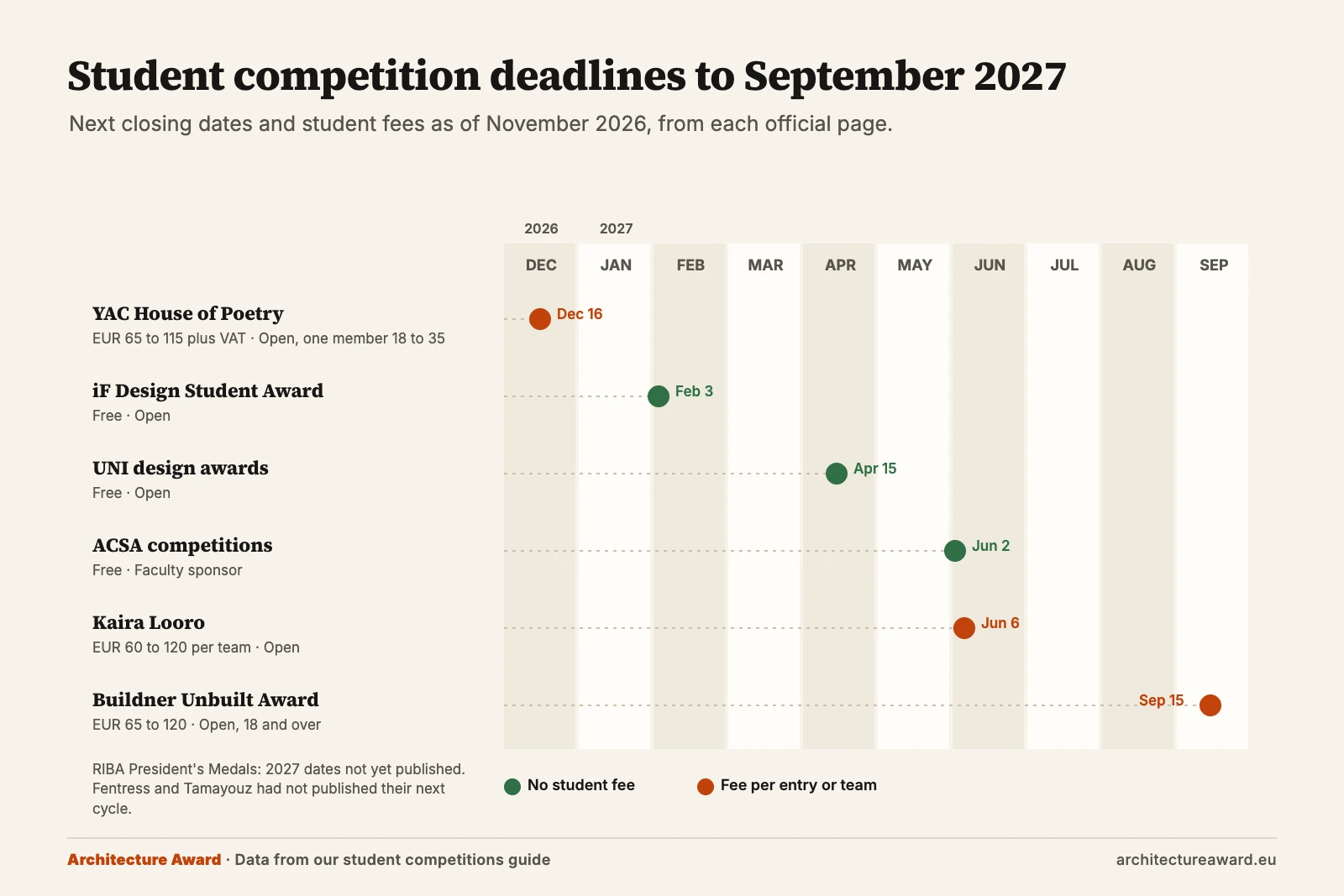
Fees as of November 2026, from each competition’s official page. Fentress and Tamayouz had not published their next cycle.
💡 Pro Tip
Before you register, find the anonymity rule and the template. ACSA disqualifies boards that show a name or school, and Tamayouz disqualifies posters that leave its templates. Both are easy to fix on day one and impossible to fix after upload.
A competition board can also become a portfolio page, so plan the layout with both uses in mind; this guide to an undergraduate architecture portfolio shows how competition work fits alongside studio projects.
Where to go from here
Our student competitions calendar keeps these architecture competitions for students in one list with their next closing date, checked on each official site.
Your Next Step: Ask your studio tutor this week whether your school nominates for the RIBA President’s Medals or sponsors ACSA entries, then pick one free open call to enter on your own.
Dates and fees change with each edition. Confirm them on the official award website before you enter.